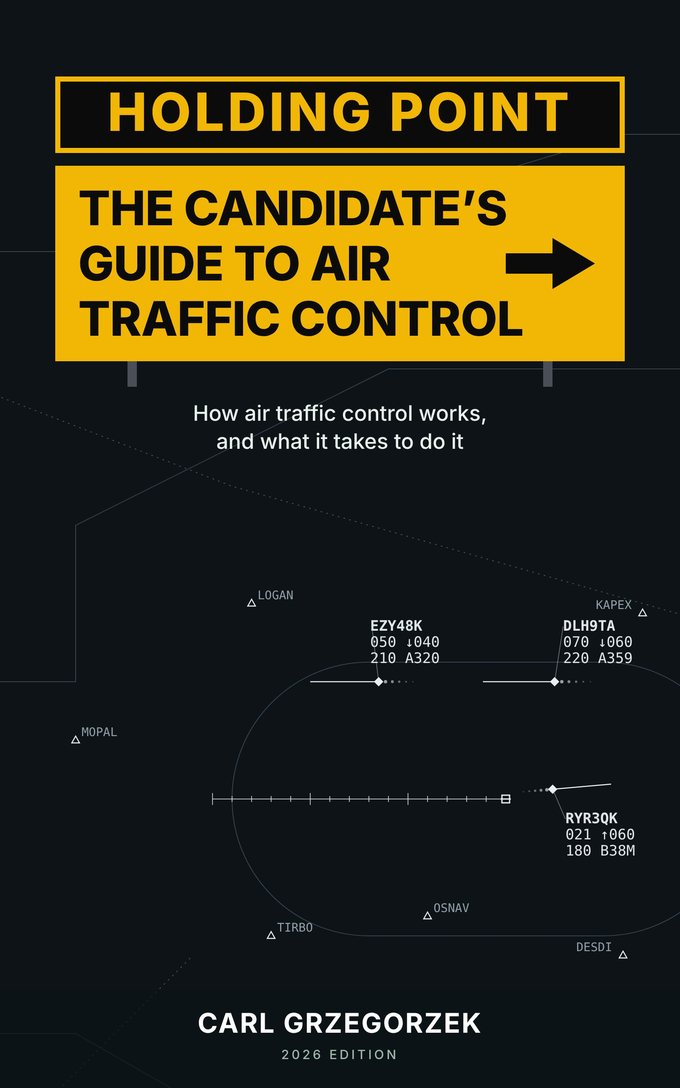
Holding Point: The Candidate's Guide to Air Traffic Control
How air traffic control works, and what it takes to do it.
Every year thousands of people apply to become air traffic controllers, and only a small proportion succeed. Written in plain English by a working controller, this book covers everything from how aircraft fly to how to answer the final interview question, so that you can apply with your eyes open and arrive at selection prepared.
- How aeroplanes fly, and how the weather affects them
- Aerodrome, approach and area control
- Airspace, navigation, radar and the controller's tools
- Separation, wake turbulence, phraseology and emergencies
- Human factors and managing error
- The skills selection looks for, training and licensing, and how to prepare for every stage of selection
More than 70 original diagrams, key points and interview tips in every chapter, and quick-reference cards for revision. 300 pages, 2026 edition.
On Amazon from 5 November 2026
£9.99, read on any device. Included with full access.
Colour paperback on Amazon from 5 November 2026.
Read the selection chapter free
Chapter 19 covers every stage of selection and how to prepare for each, including common interview questions. Enter your email address and it's yours as a PDF.
About the author
Carl Grzegorzek has been an air traffic controller since 2000. He has worked at five international airports in four countries, training and assessing controllers along the way, and has sat on selection boards.
Contents
Part 1. Foundations
- 1. Why air traffic control exists
- 2. The language of aviation
- 3. How aeroplanes fly
- 4. The atmosphere, altimetry and weather
Part 2. How air traffic control works
- 5. What air traffic control is
- 6. The three main controller roles
- 7. Airspace and flight rules
- 8. Navigation: how aircraft find their way
- 9. Surveillance and the controller’s tools
- 10. Flight plans, clearances and the rules of the air
- 11. Separation: keeping aircraft apart
- 12. Wake turbulence
- 13. Radiotelephony and phraseology
- 14. Emergencies and unusual situations
- 15. Human factors, safety culture and teamwork
Part 3. The job and how to get it
- 16. The challenges of the job
- 17. The skills selection looks for
- 18. Training and licensing
- 19. The selection process and how to prepare
- 20. The future of air traffic control
Appendices: glossary, quick-reference cards, further reading.
Practise while you readThe practice tests train the abilities the book describes, with feedback on every mistake.
Try the tests